

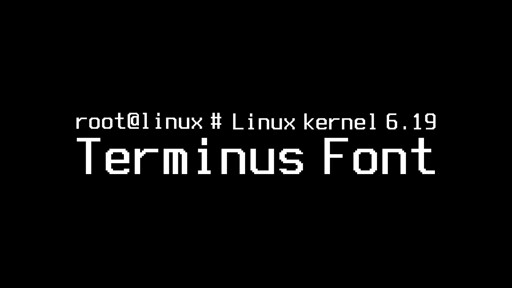
Beyond technical improvements, Linux Kernel 6.19 will also deliver something that, oddly enough, can be seen from a more aesthetic point of view. And more specifically, it is set to introduce a new Terminus 10×18 console bitmap font, offering a clearer, more balanced option for users who rely on text-mode consoles.
The addition arrives through a recent PR as part of a broader set of fbdev updates targeting the 6.19-rc1 cycle. Expectations are that the new font will improve readability in environments where console clarity still matters, especially on modern laptops and framebuffer-based systems.
The Terminus 10×18 font is designed specifically for mid-density 13–16-inch laptop displays with resolutions such as 1280×800 and 1440×900. Existing built-in fonts, most notably the long-standing 8×16 fallback used by the kernel for decades, tend to appear cramped or thin on these panels.
And if you don’t have an initramfs?
Found the Gentoo user
The Gentoo user who does not encrypt their boot drive
The Debian user who lets GRUB handle decryption AND updates (somehow, Debian is weird)
I use an encrypted rootfs without “an initramfs”. Just requires some advanced fuckery.
A little known fun fact is that almost all kernels have a tiny stub-initram built into the kernel file. This is added when initram support is enabled, and is loaded before dedicated files are. It is however possible to supply your own initram directory or archive during kernel build to replace this built-in initram, so you can bake it in without leaving a separate file. No juggling with partitions, no boot options. Works just like a normal kernel “without initram”, since even kernels without one usually do have that stub one anyway.
The downside is that a) you have to build the kernel, and b) the files to pack have to be available when the kernel is built, meaning you can’t pack in modules of the kernel. But when building your own kernel anyway you can simply set the needed modules for encryption built-in and only pack the userspace cryptsetup executable needed for decryption, that way you get it all in a single kernel build, and the output is a single uniform kernel binary capable of decrypting your boot drive. No flags, no extra files, no access to the esp needed.
(I use gentoo with encrypted root btw.)
Guys you have to see, it is amazing how much deep tech stuff you know, but dont forget you are a crazy niche within a niche and be nice to non-systems programmers XD
Nah I’m just old